
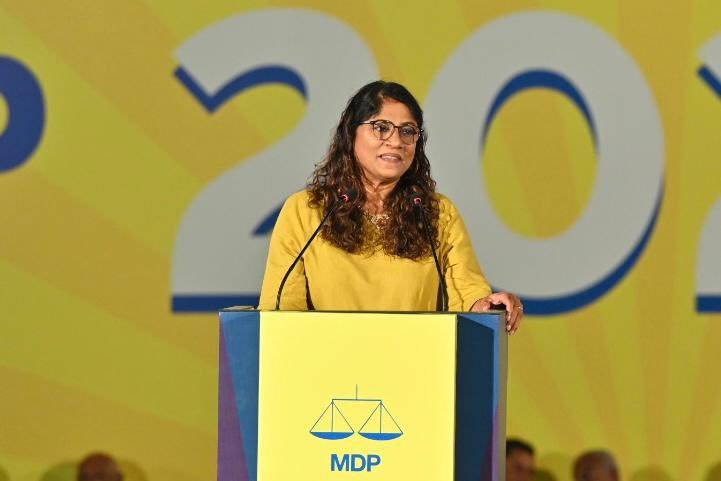
Former defence minister Mariya Ahmed Didi said on Sunday the Maldives is facing a national economic crisis requiring urgent cross-party cooperation, citing high-interest borrowing plans, resignations at the Maldives Pension Administration Office (MPAO) and weakened parliamentary oversight.
In a statement posted on X, Mariya said claims by former president Abdulla Yameen Abdul Gayoom that the government plans to refinance debt at interest rates as high as 17 percent, combined with the resignation of the chairperson of the MPAO, show the severity of the country’s economic position.
Mariya said the resignation was linked to objections over the issuance of an MVR 2.4 billion bond involving pension funds, which critics say would allow the government to increase local currency in circulation and harm the economy.
She added that the crisis extends beyond any single administration and would burden the country well past the 2028 presidential election. Mariya also criticised a recent constitutional amendment introduced by President Mohamed Muizzu, saying it weakened Parliament’s oversight role and removed a key constitutional safeguard.
“At this critical juncture, I sincerely hope President Muizzu will convene all-party talks to confront the crisis honestly and seek national consensus on solutions,” Mariya said. She further said that opposition parties should unite and set aside political differences if such talks do not take place.
Her comments follow warnings earlier on Sunday from former MDP chairperson Fayyaz Ismail, who said the Muizzu government is heading towards distress borrowing. Fayyaz weighed in after Ahmed Inaz resigned as chairperson of the MPAO, citing concerns over the same MVR 2.4 billion bond plan.
Inaz said raising funds for the transaction through the Maldives Monetary Authority (MMA) would harm the economy and does not provide a sustainable solution as state finances deteriorate. He said repeated discussions have failed to resolve his concerns.
Inaz is the third board member to resign over the issue, after Ashraf Rasheed and Ahmed Sarvash Adam. The pension office’s chief finance officer, Hawa Fajwa, also resigned after declining to sign documents linked to the transaction.
Fayyaz said the government expanded state spending while delaying fiscal reform, adding that salaries and wages rose by more than MVR 1 billion in 2025 while spending outpaced revenue growth. He warned that international markets would demand interest rates of 14 percent or higher for future borrowing, describing the approach as distress borrowing rather than refinancing.
The bond plan involves pension funds investing in a bond linked to the central bank, with proceeds used to meet government financing needs. Critics say the structure amounts to indirect money creation using pension savings.
The debate intensified after former president Yameen accused the administration of seeking to borrow at 17 percent interest to refinance a $500 million sukuk due on 8 April. Speaking at a rally last week, Yameen said such rates reflect the country’s weak credit position and place long-term strain on public finances.
Global rating agencies Moody’s and Fitch Ratings have downgraded the Maldives to a high-risk investment category, a factor analysts say raises borrowing costs and limits access to lower-yield financing.
The government has so far not revealed any plans to borrow at rates cited by critics.