
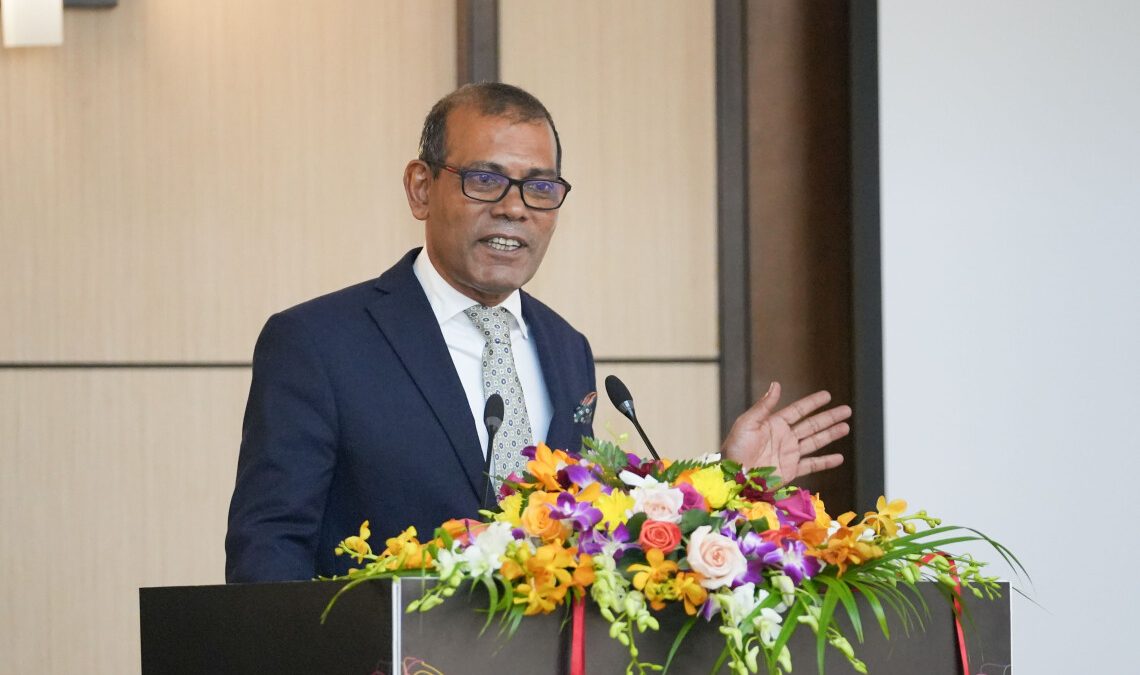
Former president Mohamed Nasheed said on Sunday that the Maldives would be firmly caught in a debt trap if the government is borrowing at high interest rates solely to repay existing loans, warning that such a cycle signals deep structural trouble in state finances.
In a post on X, Nasheed said if the only purpose of new borrowing is to settle old debt, the country is clearly heading into a debt trap. Nasheed, who also served as Speaker of the 19th Parliament, said the debt burden has grown into a national issue and cannot be resolved by the current administration alone.
Nasheed’s remarks come amid reports that the government is preparing to take out a high interest loan to meet upcoming obligations. Political figures and media reports have claimed the administration is seeking financing at rates exceeding 14 percent through Cargill Financial Services International to repay a USD 500 million sukuk maturing on 8 April. The government has not confirmed the plan. Critics say the state lacks the financial capacity to settle the sukuk without new borrowing.
Concerns over public finances have intensified following a series of warnings from senior political figures. Former defence minister Mariya Ahmed Didi said on Sunday the country is facing a national economic crisis that requires urgent cross-party cooperation. In a statement on X, Mariya cited reports of high interest refinancing, resignations at the Maldives Pension Administration Office and weakened parliamentary oversight as signs of growing strain.
Mariya linked recent resignations at the pension office to objections over an MVR 2.4 billion bond involving pension funds. Critics say the arrangement would increase local currency in circulation and harm economic stability. Mariya said the crisis would burden the country well beyond the 2028 presidential election and urged President Mohamed Muizzu to convene all-party talks to seek national consensus.
Former MDP chairperson Fayyaz Ismail also warned on Sunday that the Muizzu government is moving towards distress borrowing. Fayyaz said state spending has expanded while fiscal reform has been delayed, noting salaries and wages rose by more than MVR 1 billion in 2025 as spending outpaced revenue growth. He said international markets would demand interest rates of 14 percent or higher under current conditions.
The debate deepened after former president Abdulla Yameen Abdul Gayoom claimed at a rally last week that the government is seeking to refinance the sukuk at interest rates as high as 17 percent. Yameen said such rates reflect the country’s weak credit position and would place long-term pressure on public finances.
Global rating agencies Moody’s and Fitch Ratings have downgraded the Maldives to a high-risk investment category, a move analysts say has driven up borrowing costs and limited access to lower yield financing.
The government has not disclosed any plan to borrow at the rates cited by critics.