
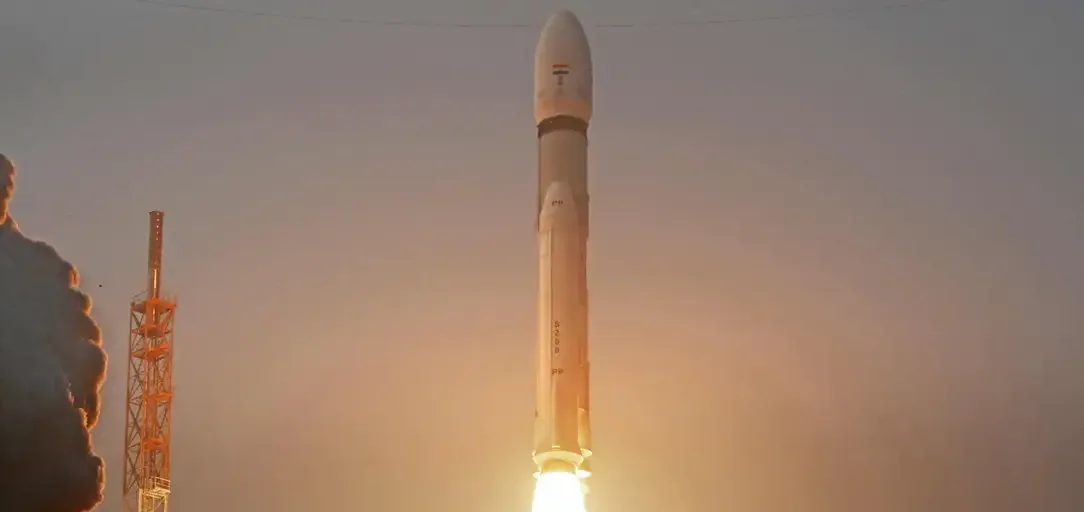
On the morning of 24 December, like countless Indians, I sat glued to my screen awaiting the Indian Space Research Organisation’s (ISRO) grand finale for 2025: the launch of a 6,100-kilogram super-heavy satellite for an American company using its flagship heavy-lift rocket, LVM3. Everything went smoothly, achieving a perfect orbit. In that moment, I suddenly realised I had been following Indian space exploration for a full 22 years.
From Perplexity to Admiration: My ISRO Awakening
It all began with confusion.
In October 2003, shortly after China’s successful Shenzhou-5 manned spaceflight, I wrote a report for Chinese domestic media titled: “India Vows to Reach the Moon Before China.” The article stated: “Among developing nations, India is arguably the only country that can rival China in space technology. And India, which has been at a relative disadvantage, has been determined to compete with China.”
Then prime minister Atal Bihari Vajpayee announced in his Independence Day speech that India would launch an unmanned lunar probe in 2007 and send an Indian astronaut to the Moon by 2015.
At the time, India displayed palpable anxiety. China’s rockets carried heavier payloads, and the Shenzhou spacecraft had already reached space. India feared being left far behind. Rumours even circulated that the United States was secretly assisting India to counter China’s rise.
Rereading this old article now is both amusing and thought-provoking.
India landing on the Moon in 2015? That seemed like a distant dream.
An unmanned probe in 2008? Delayed until Chandrayaan-1, which ultimately succeeded and discovered water molecules on the Moon.
It wasn’t until 2023 that Chandrayaan-3 achieved a soft landing at the lunar south pole, at a cost of $75 million.
What truly captivated me about ISRO, however, was something else.
In 2013–2014, India launched its first Mars orbiter, Mangalyaan, on a budget of about $74 million. The world was stunned — including Chinese netizens and international media. “How did they get to Mars with so little money?” many asked. I was among them. How could a developing nation accomplish an interplanetary mission with less funding than a Hollywood movie?
That bewilderment later transformed into profound admiration. I began to grasp ISRO’s magic: extreme frugality in engineering, ingenious shortcuts and pure perseverance. They did not need billions of dollars — just a team of brilliant minds refusing to waste a single rupee.
The most iconic example is the Mangalyaan Mars mission. With a budget of just $74 million, ISRO built only one physical model, while NASA typically constructs multiple iterative prototypes. Through hyper-precise calculations and simulations, they skipped directly to the flight version, saving massive testing costs. The project lead later recalled: “We refined every detail on paper to absolute precision to minimise costly ground experiments.”
Similarly, when Chandrayaan-1 faced budget overruns, ISRO reduced redundant components — cutting thrusters from 16 to eight — and relied on calculations to ensure safety, avoiding the need for a larger rocket.
After facing U.S. sanctions during cryogenic engine development, Indian scientists extensively used simulations to minimise hot-fire tests, ultimately ensuring the Baahubali rocket never missed a launch.
2025: Redemption After Tears, ISRO’s Classic Script
2025 marked another classic year for ISRO — tears followed by triumph.
The first half proved challenging. Two PSLV rocket launches suffered third-stage failures, resulting in satellite losses. While the SpaDEX satellite docking experiment ultimately succeeded, the connection process was bumpy and separation proved difficult.
Trolls immediately jumped in with snide remarks: “See? Indian spaceflight has crashed again,” “All that hype, and it still ended in failure,” “If you don’t have the money, don’t force it — it’s just embarrassing,” and so on. The trolls were overjoyed.
The second half delivered a dramatic reversal.
July: The $1.5 billion U.S.–India NISAR Earth observation satellite launched flawlessly.
November: Another heavy communications satellite followed.
On the morning of 24 December, the rocket affectionately dubbed “Baahubali” by Indians — officially LVM3 — effortlessly placed the 6,100-kilogram American AST SpaceMobile satellite into low Earth orbit, the heaviest single-satellite payload in LVM3 history.
Why “Baahubali”? If you have seen the Baahubali trilogy, you will get it. I watched the first film at Mumbai’s Regal Cinema — the entire audience went wild. The scene in which Prabhas, playing King Baahubali, single-handedly lifts the massive Shiva lingam perfectly mirrors this rocket’s robust, heavy-lifting prowess — never failing to deliver.
Netizens erupted: “Baahubali has lifted again!” “Our Baahubali carries America’s big guy like it’s child’s play 😂”
LVM3 relies on indigenous cryogenic technology, and V. Narayanan—appointed ISRO Chairman in January 2025—is an expert in this field. Operational record: 100% success. The United States entrusted India with launching its hundred-million-dollar treasure based on simple math: reliability, low cost, and deepening Indo-USA ties.
Looking Back: Delayed Dreams, Unwavering Brilliance
Twenty-two years ago, I chronicled India’s urgent ambition to surpass China in lunar exploration.
Twenty-two years later, I witness India effortlessly launching a massive American satellite with its indigenous rocket.
Dreams faced delays — undeniably. Yet those delays cultivated patience, creativity, and confidence.
2026 holds more ISRO highlights: the talking female robot Vyommitra will ride the unmanned Gaganyaan into space, NISAR data will flood in, and launch frequency will keep rising.
From initial bewilderment over the low-cost Mars mission “Mangalyaan” to today’s goosebumps watching “Baahubali” roar, my fascination with ISRO has only deepened.
Keep it up, India.
Slowly, frugally, brilliantly.
— A 22-year ISRO fan, still watching. Jai Hind! 🇮🇳🚀